This became an important part of Zalmanov's philosophy:
The capillaries were not merely the end of circulation. They were an active part of life itself.
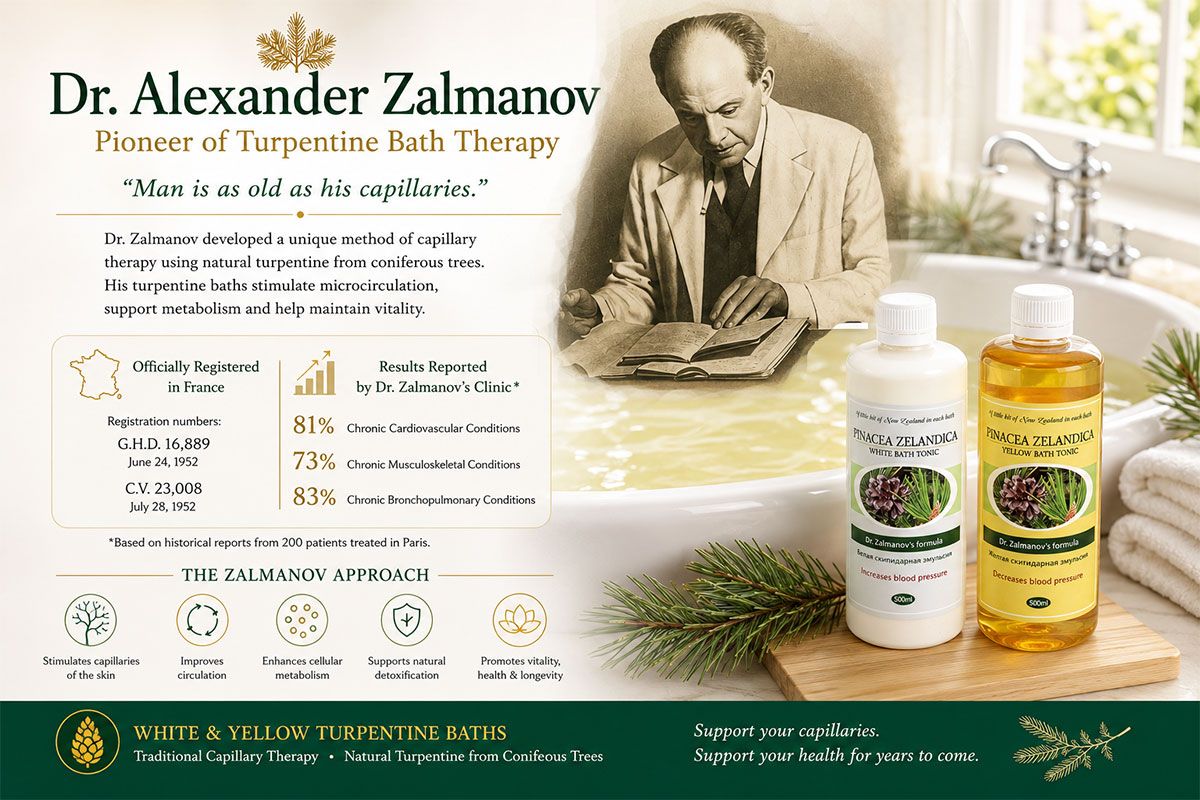
White and Yellow Turpentine Emulsions
Traditionally associated with capillary stimulation and increased peripheral vascular activity.
Traditionally associated with warming, perspiration, vasodilation and a tendency toward lower arterial pressure.
The two preparations were not simply alternatives.
Zalmanov used them in different proportions and combinations, depending on the patient's blood pressure, condition and response to treatment. The traditional method therefore allowed considerable individualization. The Secrets and Wisdom of the Body ->
The French Period
Zalmanov spent an important part of his later life in
France, where he continued developing and applying his ideas about capillary therapy and therapeutic baths.
Historical materials associated with the method cite the following French registration numbers:
G.H.D. No. 16,889 — June 24, 1952
C.V. No. 23,008 — July 28, 1952
These numbers are preserved in historical accounts of the development and registration of Zalmanov's method.
The method subsequently became known internationally and was discussed in European hydrotherapy and physiotherapy literature.
A later medical review published in the Russian Journal of Physiotherapy, Balneology and Rehabilitation describes Zalmanov as a pioneer of capillarotherapy and discusses his White Emulsion and Yellow Solution and their application in clinical physiotherapy.
The Results Reported by Zalmanov's FollowersHistorical accounts of Zalmanov's clinic report substantial improvement among patients suffering from chronic conditions.
One account describes 200 patients treated at Zalmanov's first Paris clinic and reports a high degree of
Historical sources associated with the method also cite results of approximately:
81% — chronic cardiovascular conditions
73% — chronic musculoskeletal conditions
83% — chronic bronchopulmonary conditions
The Central IdeaEverything in Zalmanov's system comes back to one question:
What happens when microcirculation slows?
If capillary circulation becomes less active, tissues receive less oxygen and nutrients and the removal of metabolic products becomes less efficient.
Zalmanov believed that this progressive deterioration of microcirculation was closely connected with chronic disease and aging.
His answer was Capillary Therapy.
And turpentine baths became its most distinctive instrument.
A Different Way of Looking at the Body
Zalmanov's philosophy can be summarized in a few words:
Do not treat the organ in isolation.
Look at the circulation that nourishes it.
Look at the capillaries.
Look at the exchange between blood and cells.
And support the body's ability to restore its own physiological balance.
This is what makes the Zalmanov method different from an ordinary therapeutic bath.
It is a whole-body approach built around microcirculation.